


Page 10 - reflections_dyslipidaemia_newsletter5_2023
P. 10
REFLECTIONS
                                                                                                                   Dyslipidaemia
     Dyslipidaemia Global Newsletter #6 2023


     Pitavastatin to prevent cardiovascular disease in HIV infection.                                              Dyslipidaemia
     Grinspoon SK, et al. N Engl J Med. 2023 Aug 24;389(8):687-699.


     The risk of ASCVD in persons with HIV is twice that in the
     general population, therefore primary prevention strategies are
     needed in this population.

     This Phase 3, multinational, randomized, placebo-controlled
     trial assessed the efficacy and safety of pitavastatin for the
     prevention of CV events in persons with HIV infection and low-
     to-moderate risk of ASCVD.

     Participants between the ages of 40 and 75 years (median
     screening LDL-C 108 mg/dL) receiving stable antiretroviral
     therapy were assigned to receive oral pitavastatin calcium
     (4 mg) (3888 participants) or placebo (3881 participants)
     daily. The primary outcome was the occurrence of a major
     adverse cardiovascular event (MACE), which was defined as a
     composite of CV death, MI, hospitalization for unstable angina,
     stroke, TIA, peripheral arterial ischaemia, revascularization, or
     death from an undetermined cause.


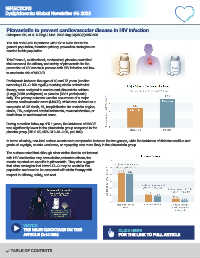
     During a median follow-up of 5.1 years, the incidence of MACE
     was significantly lower in the pitavastatin group compared to the
     placebo group (HR 0.65, 95% CI 0.48–0.90, p=0.002).

     In terms of safety, non-fatal serious events were comparable between the two groups, while the incidence of diabetes mellitus and
     grade ≥3 myalgia, muscle weakness, or myopathy, was more likely in the pitavastatin group.

     The authors noted that although other statins that do not interact
     with HIV medication may have similar protective effects, the
     results reported are specific to pitavastatin. They also suggest
     that other strategies that lower LDL-C may be useful in this
     population and need to be compared with statin therapy with
     respect to efficacy, safety, and cost.


               WATCH
               THE NEJM QUICKTAKE ON THIS                                CLICK HERE
               ARTICLE (2:14 MIN)                                        FOR THE LINK TO FULL ARTICLE


          TABLE OF CONTENTS

